
Dr Charley Schaefer
- Position
- Lecturer
- Areas of expertise
- Soft-Matter, Biophysics, Statistical Physics, Biomolecular Condensates, Protein Networks
- [email protected]
- Location
- Bragg 1.12c
- Faculty
- Engineering and Physical Sciences
- School
- Physics and Astronomy

Introduction
My lab pursues a multiscale understanding of phenomena in soft-matter and biophysics, aimed at both understanding biological function and developing sustainable materials. Within an interdisciplinary context, typically including biologists, chemists, and materials scientists, we contribute expertise in statistical mechanics, Monte Carlo and molecular dynamics to understand phenomena such as (macro)molecular diffusion, liquid-liquid phase separation, crystallisation, and rheology. We are particularly interested in the collective dynamics and interactions between proteins with high degrees of intrinsic disorder.
Current major projects
- Spinning of Silk Fibres
- Biological Physics of Pyrenoids
- Liquid-liquid phase separation
Detailed research programme
Spinning of Silk Fibres
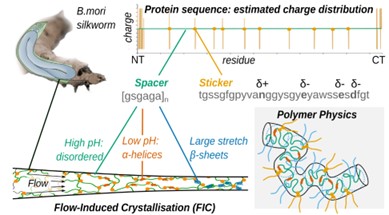
The world produces around 130 million tonnes of fibres each year—and that number is rising. About 30% are natural, like cotton and wool, while most (~60%) are synthetic, such as polyester and nylon. Making and recycling these fibres consumes a lot of energy and often uses toxic chemicals.
We look to silk for inspiration, a natural fibre spun under remarkably sustainable conditions:
- Eco-Friendly: Silk is spun at room temperature, using 90% less energy than industrial processes, with water as the only byproduct.
- Chemical Control: Silk proteins are stored in the gland at high viscosity to prevent premature solidification. As the protein approaches the spinneret, subtle changes in ions reduce viscosity, allowing the silk to flow and form fibres.
- Process Control: Different species produce silk for different purposes—some tough, some elastic. The spinneret’s shape is finely tuned with the proteins, and species control fibre properties by adjusting the drawing speed.
Our research aims to understand the design principles of silk and translate them into models that guide the flow-processing of new, sustainable materials.
Our Research:
We’ve discovered that silk proteins behave like ‘sticky polymers’ with ‘sticker-and-spacer’ regions [Macromolecules 2020]. These proteins undergo a process called extensional tumbling [Phys. Rev. Lett 2021; J. Rheol 2022], where their shape changes under flow depending on both stickiness and shear forces. We are now studying how extensional tumbling controls protein aggregation—a process that is key for spinning fibres and has important applications in biomedicine.
Biological Physics of Pyrenoids
Pyrenoids are tiny compartments in green algae that supercharge photosynthesis, helping algae fix 30% of the world’s CO₂. They do this by bringing CO₂ and Rubisco enzymes together in one place, speeding up the slowest step in photosynthesis. If we could recreate this mechanism in crops, it could increase yields and help feed a growing global population.
How Pyrenoids Work:
- Sticker-and-Spacer Proteins: A small protein called EPYC1 has sticky regions (“stickers”) that link Rubisco enzymes into a condensate—a droplet-like structure inside the cell.
- Dynamic and Flexible: Flexible “spacers” allow the condensate to rearrange itself, adapting to changes in nutrients and sunlight.
- Self-Assembling: The reversible interactions between stickers let the condensate form and dissolve as needed.
Our Research:
- We build theoretical models to describe the physical behaviour of these proteins.
- Using single-molecule experiments, we can measure protein properties and predict when condensates will form [Phys. Rev. Lett 2024].
- Current work explores how pyrenoids respond dynamically to environmental fluctuations, revealing how nature optimizes photosynthesis under changing conditions.
Just as we study silk to understand nature’s material design, we study pyrenoids to uncover nature’s chemical engineering, with the goal of guiding sustainable solutions in agriculture and biotechnology.
Liquid-liquid phase separation
Liquid–liquid phase separation (LLPS) is a fundamental physical process in which a homogeneous solution separates into two coexisting liquid phases—like oil and water. In biology, LLPS underlies the formation of biomolecular condensates: dynamic, membrane-less compartments that concentrate and organize specific molecules inside cells. LLPS also plays a key role in the structure and performance of soft materials.
Within our research, LLPS provides a unifying framework across systems and scales—from silkworm silk to cellular organelles and synthetic membranes.
Examples in our work:
- Silk spinning: Silk proteins undergo LLPS-like transitions that organize fibroin into strong fibres coated by sericin.
- Pyrenoids: Algal pyrenoids form liquid-like condensates of Rubisco and EPYC1, concentrating CO₂-fixing enzymes.
- Aggresomes: In E. coli, stress-induced protein condensates help bacteria tolerate heat shock or antibiotics.
- Lipid membranes: LLPS between lipid species generates liquid-ordered domains that tune membrane mechanics and function.
Our research:
In both biology and engineering, LLPS often responds to gradual environmental changes, posing challenges for modeling. Continuum (mean-field) models fail to capture early stages, while molecular models are computationally too demanding for large systems or long timescales. We develop bespoke coarse-grained models that capture macroscopic LLPS phenomena while faithfully representing the underlying molecular properties.