
Double success at Biochemical Society Awards
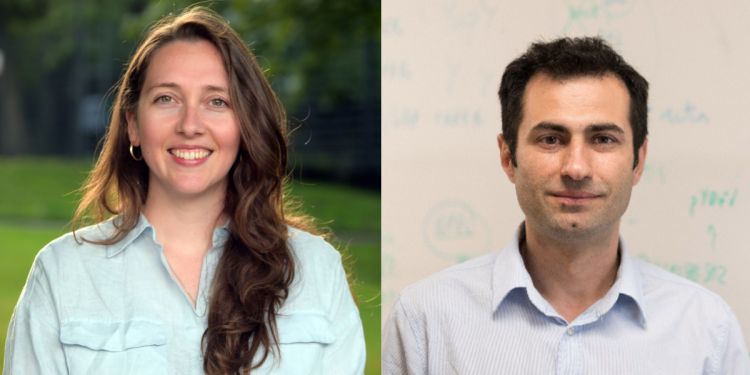
Professor Elton Zeqiraj, Professor of Structural Biology in the Astbury Centre and the School of Molecular and Cellular Biology was honoured with the 2027 Sustained Excellence Award, an award which recognises sustained excellence in research, alongside a strong commitment to developing, supporting and nurturing future talent.
Meanwhile Dr. Helen Foster, a Lecturer in Cryo-Electron Tomography, also in the Astbury Centre and the School of Molecular and Cellular Biology, received the Early Career Research Award for her outstanding contribution to research impact.
Both winners will receive their prize and deliver an award or medal lecture in 2027.
From molecular insights to the promise of new treatments
Professor Elton Zeqiraj is Professor of Structural Biology and a Wellcome Trust Senior Research Fellow at the University of Leeds, where he leads a research group in the Astbury Centre for Structural Molecular Biology.
He completed his BSc at the University of Westminster before undertaking a PhD at the University of Dundee, where his landmark work elucidated the structure of the LKB1 tumour suppressor complex.
After postdoctoral research at Mount Sinai Hospital, Toronto, he established his independent laboratory in Leeds in 2016 with a Sir Henry Dale Fellowship.
His research focuses on understanding the structure of proteins and how they assemble, their interactions with drug molecules, and how changes in their structure cause disease using an interdisciplinary approach spanning structural and chemical biology, and biochemistry.
A recent breakthrough was the discovery of a new molecular glue, which brings exciting promise in treating autoimmune diseases, such as Lupus and Scleroderma.
Closely linked to this is the group’s research into DNA damage repair in Cancer, where together with national and international collaborators they have provided structural insights into the BRCA1-A complex – a tumuor suppressor which repairs DNA.
The laboratory has also made significant contributions to our understanding of metabolic enzymes and how the drug metformin - a type of medication used to control type 2 diabetes - helps manage blood sugar levels.
Throughout all of these areas, the group draws on cutting-edge technology here at Leeds including cryo-EM, structural mass spectrometry, and chemical biology to dissect how large, dynamic multi-protein assemblies function and to develop the basis for new treatments for diseases.
Beyond research, Elton is a dedicated mentor who has nurtured the careers of numerous students and early-career researchers, and supported the scientific community in advancing early discoveries towards clinical application.
Commenting on his award, Professor Zeqiraj said
“I am truly honoured to receive the Biochemical Society Award for Sustained Excellence. This recognition reflects not just my efforts but the dedication, creativity, and hard work of every member of my research team, past and present, and the many collaborators who have made our discoveries possible.
“I could not have imagined the opportunities that science would open up for me, and I hope this award inspires others to pursue careers in the molecular biosciences.
This recognition gives us tremendous momentum as we work to translate our fundamental discoveries into new treatments and continue to push the boundaries of how we understand cell signalling in health and disease.
Targeting disease using structural molecular biology
Dr. Helen Foster joined University of Leeds in 2025 after completing her postdoctoral research in the lab of Gaia Pigino at the Human Technopole Milian, and her PhD with Andrew Carter at the MRC Laboratory of Molecular Biology in Cambridge. During this time, she combined advanced imaging with structural biology techniques to explain how molecular motors are regulated and how subcellular organelles called cilia are generated.
Her current research aims to understand how nanoscale changes within immune cells control the immune response, with a focus on using structural cell biology techniques to investigate the role of the cytoskeleton and intracellular transport factors in this process.
In addition to increasing our understanding of immune function in health and disease, this has potential to identify new targets for immune function which could be used to improve cancer treatments.
"I am delighted and incredibly honoured to receive an Early Career Award from the Biochemical Society,” said Dr. Helen Foster.
Receiving this recognition is really motivating for me to continue tackling difficult problems using structural cell biology and I hope it will highlight the work in my newly established lab, which focusses on understanding the molecular basis of how our immune responses are controlled.
Dr. Foster joins a distinguished group of researchers in the Faculty of Biological Sciences who have also been honoured with the award, including Drs. René Frank (2010), Glyn Hemsworth (2015) and Qian Wu (2019).