
Aromatic persuasion: how a plant toxin unlocks human ion channels
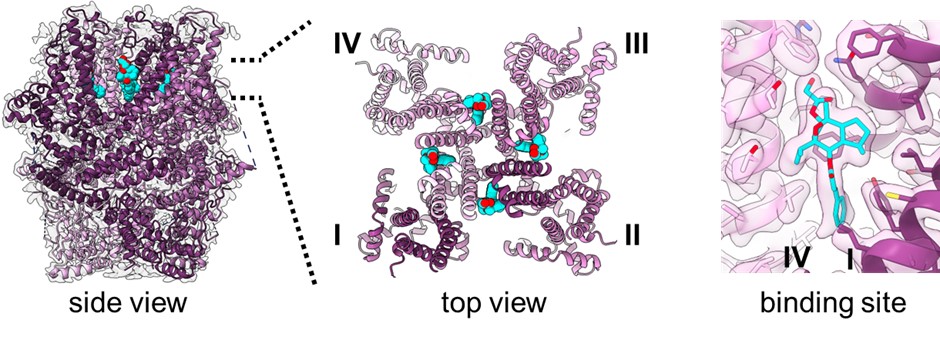
High-resolution protein structures reveal how an intriguing plant-derived molecule activates human ion channels, with a little help from a finely tuned aromatic interaction network.
Plants have evolved a dazzling array of natural chemicals to either deter hungry herbivores or attract the animals that help with pollination and seed dispersal. Bitter toxins, irritants and poisons discourage consumption, while enticing flavours, colours and aromas encourage it. In turn, animals have evolved sensory systems to detect, tolerate, or exploit these compounds.
Examples of this co-evolution are provided by transient receptor potential (TRP) proteins, which form tetrameric ion channels that mediate cellular signalling in response to a wide range of chemical and physical stimuli, including temperature, pH, mechanical force, lipids, metal ions and small molecules.
Many TRP channels also act as receptors for natural products found in food and herbal medicines, including capsaicin (chili pepper; TRPV1), menthol (mint; TRPM8), allyl isothiocyanate (mustard; TRPA1), cinnamaldehyde (cinnamon; TRPA1) and galangin (galangal; TRPC5).
The natural product (-)-englerin A (EA) was extracted from an African shrub used as both a traditional medicine and a poison. EA first drew attention because of its remarkable ability to kill certain cancer cells. The discovery that EA achieves this through potent and selective activation of TRPC4 and TRPC5 ion channels has fuelled intense research interest, including TRPC4/5 drug discovery programmes. However, despite years of study, the precise nature of the EA’s interaction with its target channels had remained a mystery.
A study led by researchers at the Astbury Centre, in collaboration with colleagues at the Czech Academy of Sciences, has revealed how EA binds to and activates the TRPC5 ion channel. The work provides a long-awaited structural explanation for the potency and selectivity of this widely used compound and opens new avenues for drug discovery targeting TRPC channels.
Using the Astbury Centre’s state-of-the-art cryo-electron microscopy facility, the team determined nine high-resolution structures of human TRPC5 in different functional states and ligand-binding conditions. These structures, supported by mutagenesis experiments, show that EA binds within a conserved lipid-binding pocket located between channel subunits, where it reshapes an aromatic interaction network crucial to channel gating.
Prof. Robin Bon commented:
(-)-Englerin A has been an extraordinarily useful pharmacological tool for the TRPC field, but until recently we did not understand how it works at the molecular level. By combining structural biology with mutagenesis, we have mapped out the key interactions that underlie channel activation, which provides a clear framework for understanding how small molecules can control the function of TRPC5 and related ion channels. The high-resolution structures of different channel states will also enable better design of new drug-like TRPC channel modulators.
Dr Sebastian Porav, first author of the study, added:
"By varying how we delivered (-)-englerin A to the channel, we were able to capture it in several different states, effectively catching snapshots along the pathway from closed towards open. It was striking to see that the channel doesn't need to be fully loaded with the molecule to start changing shape. These intermediate structures give us a much richer picture of how TRPC5 works, and it points to a feature that may be shared by other channels in the same family."
Read the article “(-)-Englerin A binding to human TRPC5 exposes an aromatic interaction network in channel activation” in Nature Communications.