
Colourful TRP tease: chromatic control of ion channels
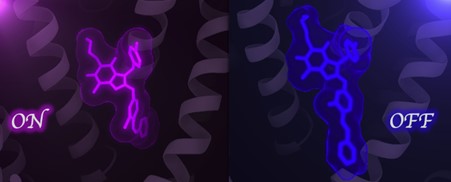
New photo-switchable chemical probes allow the precise control of ion channel activity in cells and tissues using different wavelengths of light.
A study by a consortium of researchers from Germany and the Astbury Centre demonstrates the concept of ‘ideal efficacy switching’ as an exquisite way to control biological activity.
The work, led by Prof. Oliver Thorn-Seshold (TU Dresden) and Prof. Michael Schaefer (University of Leipzig), includes contributions from Astbury researchers Dr Sebastian Porav, Dr Claudia Bauer, Dr Aidan Johnson, Prof. Stephen Muench and Prof. Robin Bon.
Controlling the activity of proteins in cells and tissues is crucial for biological research. A powerful approach is provided by photopharmacology, in which light is used to tune the bioactivity of protein ligands. However, most photoswitching is based on changing the binding affinity of chemical probes, which makes functional outcomes dependent on both the light source and local probe concentration.
The latter is difficult to control in complex biological systems.
In contrast, the outcome of ‘ideal efficacy switching’ depends only on the colour of light used, offering complete chromocontrol of protein activity. In this study, ideal efficacy switches were used to tune endogenous TRPC4/5 channel activity. Application in ex-vivo intestinal segments showed that, even at super-saturating concentrations of photoswitch, TRPC4/5-dependent contractility could be fully tuned by adjusting the irradiation wavelength.
Prof. Robin Bon explained:
“Our previous work showed that small chemical changes could dictate whether a TRPC4/5 ligand activates or inhibits the channels. We wanted to exploit our detailed structural understanding of this phenomenon in the development of photoswitches. When we realised that the Thorn-Seshold and Schaefer groups were also working on this, we joined forces. In Leeds, we studied the molecular mode-of-action of compounds developed by Markus Müller (Thorn-Seshold lab). For this, we used cryo-electron microscopy-based structure determination (in the Astbury Biostructure Laboratory) and mutagenesis studies. It was fantastic to contribute to the work by this international consortium – a real example of team science.”
Read the article “Ideal efficacy photoswitching for chromocontrol of TRPC4/5 channel functions in live tissues” in Nature Chemical Biology.
Read the News & Views article “Pick a color to control TRP channels".
Read a press release from the University of Leipzig.